
An L sealing machine rarely gives much warning before it starts letting you down. Seals turn patchy and packs have to be wrapped again, which soon puts a whole shift behind and the cause is often something small that regular attention would have caught.
Good L sealer maintenance doesn’t have to be complicated, but it does help to know which jobs your team can safely take care of and which belong to a trained engineer. Getting that split right protects both the machine and the people using it. Before we get into the checks, it’s worth looking at why upkeep matters so much on a machine that works this hard.

Why Is L Sealer Maintenance Important?
In practice, L sealing machine maintenance is about keeping seals consistent and the machine working for longer. A seal that’s patchy or incomplete means a pack that has to be wrapped again, so a machine that’s looked after saves time as well as film. Servicing also reduces downtime and costs, extends the lifespan of your shrink wrap machinery and reduces the chances of needing more repairs. Regular servicing and repairs catch small issues before they become big problems, which matters most on a machine that’s in constant use.
There’s a legal side to this for employers. The Provision and Use of Work Equipment Regulations 1998, usually shortened to PUWER, say that an employer must make sure work equipment is kept in efficient working order and good repair. Where a machine has a maintenance log, it has to be kept up to date too. In practice, that means someone needs to be responsible for arranging servicing and repairs on your L sealer and for recording them.
The duty doesn’t only sit with the employer. It also reaches anyone who controls the machine or how it’s used, to the extent of that control, which could include a packing or site manager. If you only operate the machine, arranging maintenance usually sits with your employer instead, but it helps to report anything that looks wrong. The HSE’s guidance on maintaining work equipment says it expects maintenance to be carried out only by competent people with the right information and training.
Why Are L Sealing Machines So Important for Packing Different Products?
An L sealer wraps a product in one layer of film above and below and the frame then seals the film on two sides. Our custom large L sealing machines handle items up to 3m x 3m, from envelope size right up to boxes over 1500mm. That range is why L sealing wrapping machines are so useful wherever the product mix keeps changing. They’re used for boxes and food products as well as electronics and cosmetics. Books and catalogues go through them too, as do DVDs, CDs and large bulky items.
Mixed work is typical of print and paper packaging, where one machine may see a lot of different jobs. That’s exactly the kind of machine that benefits most from upkeep, because each new product puts the same sealing system to work in a slightly different way. The parts that work hardest tend to wear first, which on an L sealer usually means the sealing wire or seal bar and the PTFE tape or silicone pad, where fitted. Those are the first places to look when you check the machine over.

Does the Same Maintenance Apply to Custom L Sealers and the Titan?
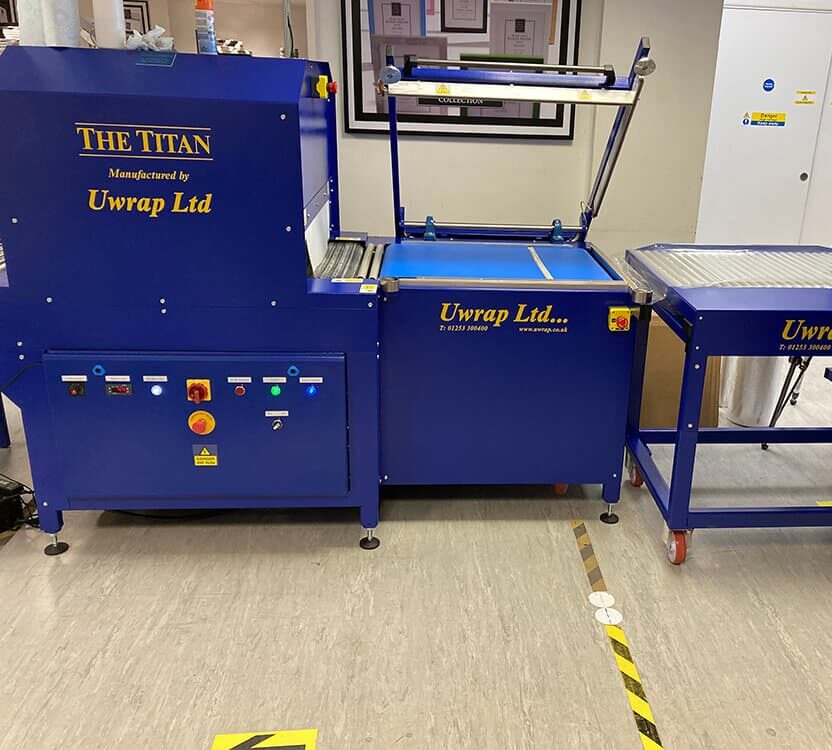
Most of the advice here applies to both of our machine types, but they aren’t identical, so it helps to know what you’re looking after. Our custom L sealers are built to order and can be a semi-automatic L sealer or an automatic one, which means two custom machines can differ in how they’re set up. The Titan shrink wrapper is a heavy-duty combination of an L sealer and shrink tunnel, which plugs in and runs up to 20 items a minute.
That affects how you look after each one. On a custom build, the manual for your exact machine is the best guide to which parts it has and what needs attention, which is why the checks below say “where fitted”. The Titan has the tunnel to look after as well as the sealing section and it’s designed for continuous running, so steady upkeep matters even more. The tunnel is a heated part like any other, so the same rules apply: isolate the power, let it cool fully and leave anything inside to an engineer.
What Can You Safely Check on an L Sealing Machine Yourself?
Before you touch anything, isolate the power and give any heated parts time to cool fully, because sealing elements get hot enough to burn. With the machine isolated and cool, there are a few checks an operator can sensibly make and each one is about spotting wear or build-up before it affects a seal:
- Look over the sealing wire or seal bar, where fitted, for dirt, residue or visible wear.
- Check any PTFE tape or silicone pad, where fitted, for signs of wear.
- Check the film is threaded correctly and held at the right tension, since film that’s loose or uneven can affect the seal.
- Confirm the settings haven’t been changed from those set for the product you’re running.
- Clear any film residue, which usually takes only a few minutes.
That’s as far as operator-level L sealer maintenance should go. Anything to do with the heating or wiring is for a trained engineer, as are the controls, including relays and thermostats. Nobody should work on any of it while the machine is live. If a shrink wrap machine isn’t sealing even after these checks, it needs an engineer’s attention. The same applies if you notice any of the warning signs that a shrink wrap machine needs a service.
How Often Should You Book L Sealer Servicing?
For L sealer servicing, our general recommendation for shrink wrap machines is at least every 12 months and about every six months in high-volume production. That’s a general shrink wrap machine recommendation rather than a schedule written for L sealers, so the manual for your own machine is the best guide to an exact interval. If your workload changes a lot during the year, it’s sensible to talk through the schedule with us rather than wait for something to go wrong.
A service is part of our repair service. Each visit includes a full inspection of all mechanical and electrical components and the key working parts are cleaned and kept running smoothly. That means an engineer checks the electrical side, not your team. It’s also sensible to keep a simple record of each service and repair, noting the date and what was done. Those notes show up any part that keeps needing attention and give an engineer a useful starting point next time. They also support the maintenance log that PUWER expects you to keep up to date.
When Should You Call an Engineer for L Sealer Repair?
Call an engineer as soon as a problem goes beyond the operator checks above, or whenever a check turns up something you can’t put right safely yourself. Anything involving the heating, wiring or controls falls into that group. If you’re unsure which side of the line something sits, it’s safer to ask than to open the machine up.
Our engineers bring over 30 years of experience to l sealing machine repair, from minor adjustments to major overhauls. That covers rollers, conveyors, sealing systems and drive components as well as electrical components and our shrink wrap machine repair work extends to machines of any brand, not just our own. Where downtime isn’t an option, we also offer urgent callouts and emergency repair services, which helps when a stopped machine holds up the rest of your line. We repair and hold spares for machines manufactured in a range of countries, so where yours was made shouldn’t be a barrier.
Can You Keep Packing While Your L Sealer Is Being Repaired?
Packing doesn’t have to stop while your machine’s away. Our short-term machine hire comes with delivery and setup and each machine is tested before it leaves us. It’s possible to hire a shrink wrap machine while yours is being repaired, so the gap doesn’t have to mean lost orders.
The closer the hire machine is to your own, the better, because a similar format means you avoid reworking your packaging dimensions. Film sizes and the way you load products can stay as they are, so the switch doesn’t have to disrupt the rest of your packing line. It’s worth telling us the sizes of the products you pack when you ask about hire, so the machine suits them from the first run.
Should You Repair, Revamp or Replace an Ageing L Sealer?
An ageing machine doesn’t automatically need replacing and the right choice usually becomes clear once you look at how it’s behaved. Check the service records you’ve kept for a pattern, such as whether faults keep coming back to the same part, how much time the machine has spent down lately and whether it still copes with the sizes of product you pack now. Repairs and revamps are both part of what we do and a repair is usually much cheaper than buying new equipment, so those answers tell you which option is worth considering first.

When Is Repairing an L Sealer the Right Choice?
Repair makes sense when a problem traces back to one part or one area and the machine otherwise suits your work. Our engineers repair rollers, conveyors, sealing systems and drive components as well as electrical components, so a fault in any of those doesn’t mean the whole machine has reached the end of its life. If it’s down occasionally but still handles your products, repair is usually the right place to start.
When Does a Revamp Make Sense?
A revamp sits between repair and replacement. It suits a machine that’s showing its age in more than one place but still suits the products you pack, where fixing one fault after another has started to feel like patching. We can talk through what a revamp would involve for your particular machine before you decide.

When Is It Time to Replace an L Sealer?
Replacement makes sense when the machine itself no longer fits what you do. That might be because your products have outgrown it, or because repairs keep returning to the same parts and the downtime is costing more than the machine is worth. If your products have outgrown it, a heavy-duty L sealer machine may make more sense than repeated repairs.
We supply new shrink wrap machines and because our custom L sealer machines are built to order, a new one can be matched to the sizes you pack now. Our used shrink wrapping machines are an alternative where budget matters. Whichever you choose, the machine’s age and repair history, the products you pack and how hard it works are worth weighing together.
Looking across everything above, the condition of the machine is what ties it all together. Your operator checks show how it’s behaving day to day, a service gives an engineer’s view of what’s wearing and the records you keep turn both into a history you can act on. That history makes the bigger decisions straightforward, whether it’s repair, hire cover, a revamp or a new machine. It also helps keep your L sealer earning its place on the packing line for as long as it can.
If you’re not sure whether your L sealer needs a service, a repair or a longer-term rethink, tell us the model and what you’re seeing through our contact us page. We repair machines of any brand and we can talk you through whether a repair, revamp or replacement makes the most sense, so you can decide with a clear picture of where your machine stands. Our team is available Monday to Friday, 9am to 5pm.
